Start with the quilt you want to make
Needle and thread choices depend on more than the design stitched into the quilt. Consider the thickness of the quilt sandwich, how densely you plan to quilt, and whether you want the stitches to stand out or blend into the fabric. A thread that looks subtle on a spool may become prominent when it crosses several fabric colours.
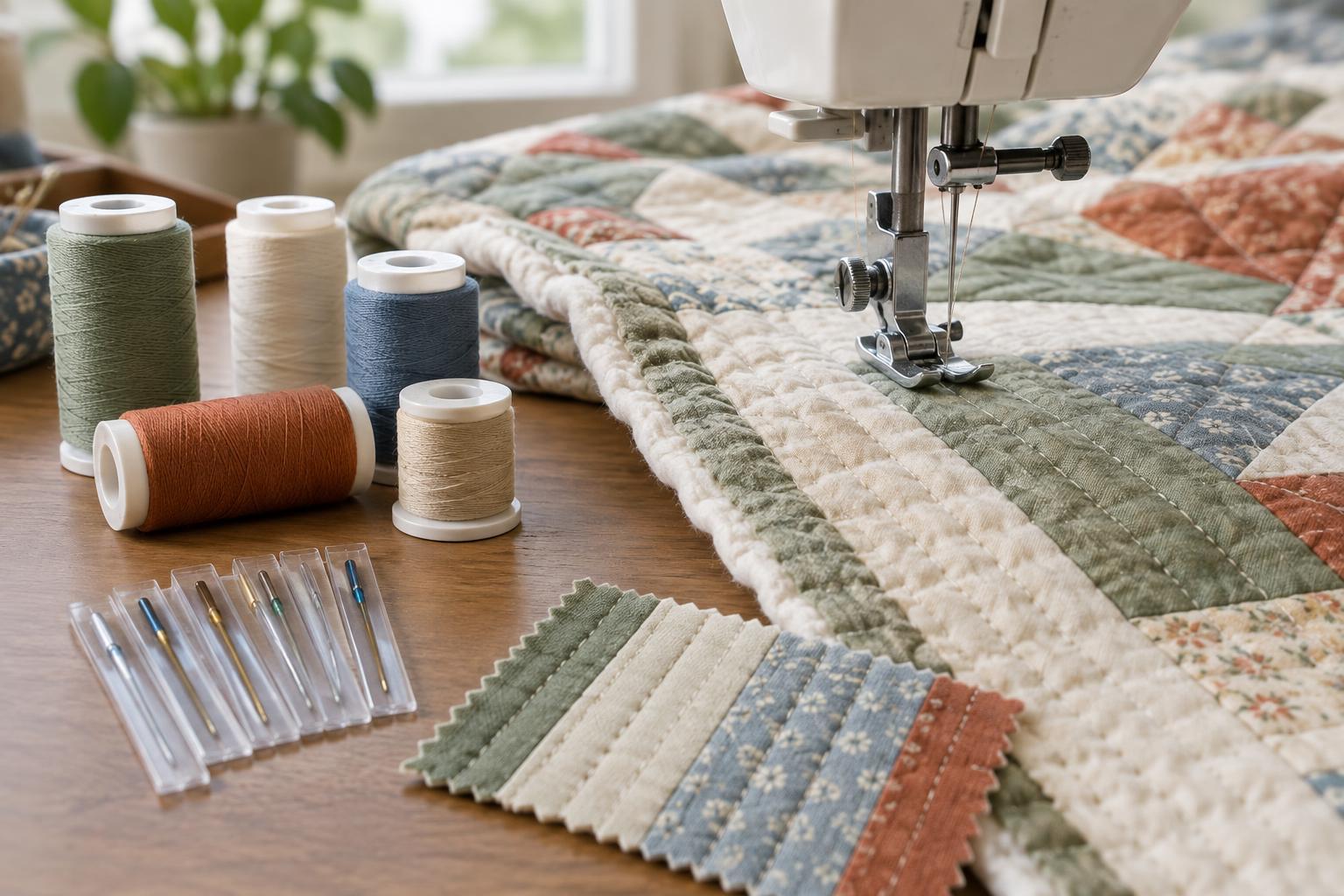
For a first machine-quilted project, a smooth, good-quality 50-weight thread and a fresh 80/12 quilting or topstitch needle are reasonable starting points. They are not universal rules: a thicker thread, dense batting or heavily layered seams may call for a larger needle. Test the combination on scraps from your project before committing to the quilt.
Choose a needle that suits the thread
Machine needle sizes describe the needle’s diameter; a 90/14 is larger than an 80/12. The needle needs to make a path through the layers while giving the thread enough room to move without excessive friction. A needle that is too small for the thread can contribute to fraying or breakage. One that is unnecessarily large may leave more visible holes, especially in closely woven fabric.
Quilting needles are designed to pass through a quilt sandwich, while topstitch needles have a relatively roomy eye that can help with heavier or decorative thread. Either can work for many quilting projects. Start with the type recommended for your machine and fabric, then adjust based on the test stitches. Needle brands and designs vary, so size alone does not guarantee the same result.
Use a new needle when beginning a substantial quilting session or whenever the old one seems bent, blunt or damaged. Skipped stitches, unusual tapping sounds and thread shredding can all be reasons to check it. Insert the replacement fully and in the orientation specified by your machine manual.
Pick thread for appearance and handling
Thread weight affects how the quilting looks. In common thread-weight labelling, a lower number generally indicates a thicker thread: 40-weight thread tends to show more than 50-weight thread. Labels are not perfectly consistent across manufacturers, so compare the actual threads as well as the numbers. A fine thread can keep the focus on the patchwork; a thicker one can make simple quilting lines part of the design.
Cotton thread offers a matte look that many quilters like alongside cotton fabric. Polyester thread is available in a wide range of colours and often has a little more strength for its thickness. Either can be suitable for machine quilting if it runs reliably through your machine. Smooth, low-lint thread may make stitching easier to manage, although regular machine cleaning remains important.
You do not always need identical thread in the needle and bobbin. Matching colours can make small tension variations less noticeable, while a bobbin colour chosen for the backing can give the quilt a tidier reverse side. If you use different threads, test them together: a significant difference in thickness or behaviour may require a tension adjustment. Check your machine manual for any bobbin-thread restrictions.
Test on a realistic quilt sandwich
Make a practice sandwich using the same top fabric, batting and backing as your quilt. Include a seam intersection if your quilt has many of them. Stitch a few straight and curved lines at the speed you expect to use, then look at both sides. The stitches should form consistently, without loops, shredding or repeated skipped stitches. Check whether the thread colour and stitch length suit the finished quilt.
Change one thing at a time if the test is unsatisfactory. First, rethread the machine with the presser foot raised, confirm that the bobbin is seated correctly, and try a fresh needle. If the thread still frays, consider a larger needle or a different needle type. If loops appear, check the threading before making small tension changes according to your manual. Keeping track of each change makes it easier to identify what helped.
Build a dependable starting kit
You do not need a large thread collection to begin machine quilting. A few versatile thread colours, fresh needles in two nearby sizes, and scraps for testing will cover many projects. Choose thread colours by laying a length across the actual quilt top rather than judging only from the spool. For multicoloured patchwork, a medium-value neutral often blends more readily than a very light or very dark thread.
Keep a note of the needle, upper thread, bobbin thread and settings that worked for each quilt. The next project may need a different setup, but those notes give you a useful place to start. The goal is not to find one perfect needle-and-thread pairing; it is to find a combination that stitches cleanly and gives your quilt the look you want.