See the block as a nine-unit grid
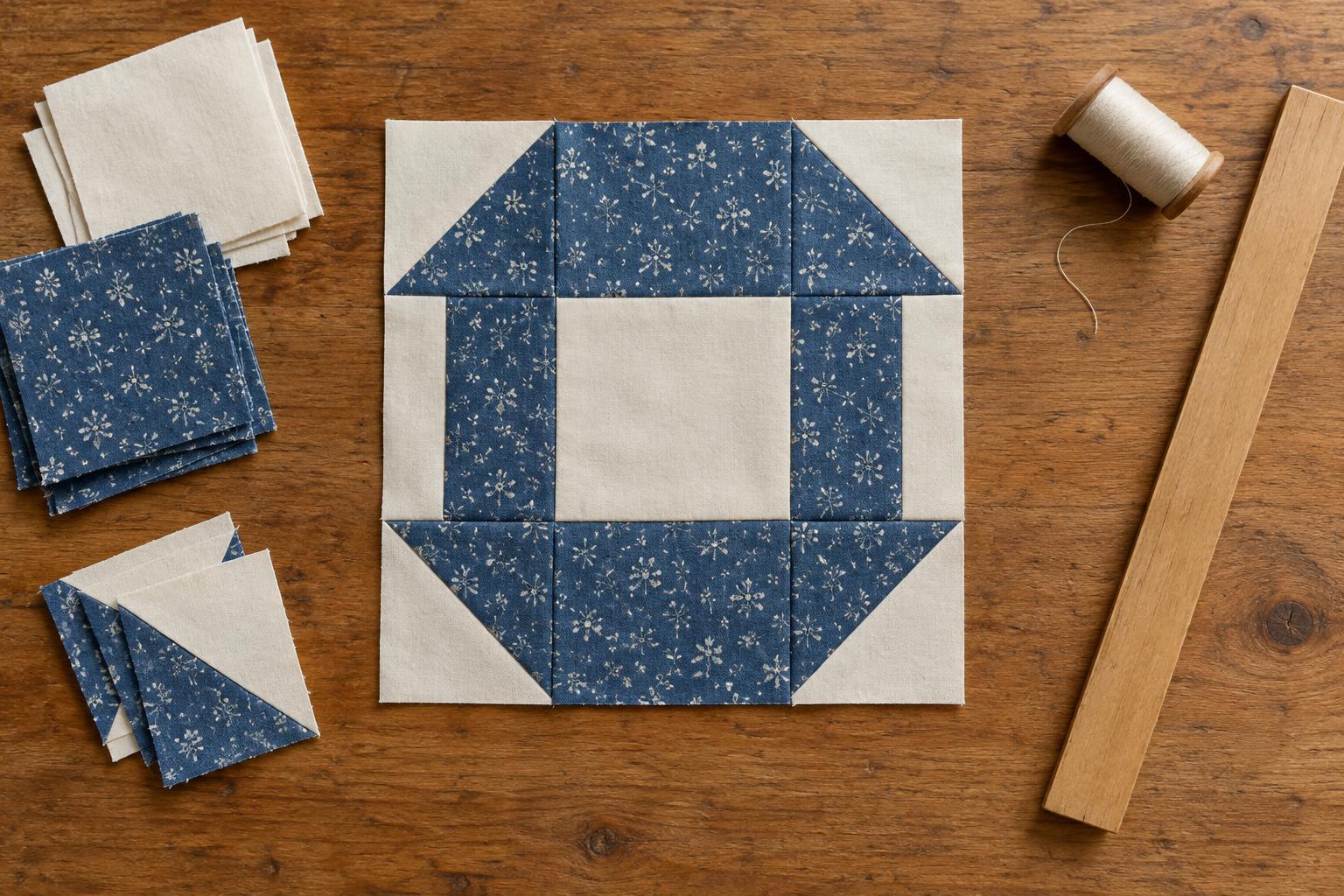
A Churn Dash block is easier to understand when you look past its outline and see three rows of three units. A plain square sits in the middle. Four strip-pieced units sit above, below and beside it, while four half-square triangles fill the corners. Together, the strips and triangles create the distinctive frame around the centre.
Before cutting fabric, decide which colour will carry that frame. In a two-fabric block, the darker or stronger fabric often forms the strips nearest the centre and the triangles at the inner corners. The other fabric provides space around them. Contrast matters more than a particular colour choice: if the two fabrics look nearly identical from a short distance, the frame may be harder to see.
Cut pieces for a 12-inch finished block
This example uses a consistent quarter-inch seam allowance and makes a block that measures 12½ inches before it is sewn into a quilt, or 12 inches finished. Each position in the three-by-three grid finishes at 4 inches. Cut one 4½-inch square for the centre. For the four edge units, cut four 2½-by-4½-inch strips from the frame fabric and four of the same size from the background fabric.
For the corners, cut two 5¼-inch squares of each fabric. Pair each frame square with a background square, right sides together. Mark one diagonal on the back of each pair, sew a quarter inch on both sides of the line, then cut along the line. This produces four half-square triangles. Press them and trim each one to 4½ inches square, keeping the diagonal centred at the corners. The extra cutting allowance gives you room to trim; it is not part of the finished unit.
If you prefer a different block size, start with the finished size of one grid position: it is one-third of the finished block width. Add half an inch to that measurement for the centre square and the final size of each pieced unit before assembly. Check the cutting sizes for the strip and triangle methods you plan to use rather than scaling every piece by eye.
Build and arrange the frame
Sew one frame strip to one background strip along their long edges to make each edge unit. Press the seams consistently and check that every unit measures 4½ inches square. Arrange the four units around the centre with their frame-coloured strips facing inward. You should see a band of colour on all four sides of the centre square, with small gaps where the corner units will go.
Place a half-square triangle in each corner. Turn each one so its frame-coloured triangle points toward the centre of the block. Its coloured edges should meet the frame strips in the neighbouring edge units, continuing the shape through the corners. Stand back and inspect all nine units before sewing: a single reversed triangle or outward-facing strip can change the pattern noticeably. Taking a quick photo of the layout can help you restore it if the pieces are moved.
Sew the rows without losing the points
Join the three units in each row, keeping the quarter-inch seam allowance steady. Press the seam allowances in the top and bottom rows in one direction and those in the middle row in the opposite direction, if the fabric bulk allows. The opposing seams can nest when you join the rows. Pin at the junctions, then sew the rows together and press the completed block.
Check the block with a ruler before adding it to a larger project. It should measure 12½ inches square, and its centre square should sit evenly within the frame. If a point looks clipped, check whether the seam crossed the triangle’s tip; if a row seems short, check the seam allowance and the size of its units. Small differences are easier to address in one block than after several blocks have been joined.
Use the centre to vary the pattern
Once the construction feels familiar, keep the frame layout and change only the centre square. A quiet print can soften a bold frame, while a solid centre gives the pieced edges more attention. For a scrappy quilt, repeat one background fabric across several blocks and vary the frame fabrics. The shared background helps the blocks relate to one another without making them identical.
Lay out a few finished blocks before choosing their final order. Adjacent Churn Dash frames can create a lively rhythm, especially when their colours alternate. The block’s appeal lies in that balance: a straightforward centre, a carefully built frame and enough contrast to make both visible.