Why straight cuts can turn into bowed strips
A strip cut from folded fabric may look even under the ruler but open into a shallow V, sometimes called a dogleg. This usually means the cut was not square to the fold. The ruler may have followed a mat line while the fabric fold sat at a slight angle, or the layers may have shifted as the cut was made.
A small error matters because a strip extends across a wide piece of fabric. Once opened, a bend at the fold can make long borders or binding strips harder to sew accurately. The aim is not to pull the fabric into a perfectly straight-looking shape. It is to let it lie flat, then cut at a right angle to a stable fold.
Prepare the fabric so it lies flat
Press out creases before cutting. Use a comfortable pressing method for the fabric, and let it cool and dry before moving it to the mat. If you plan to prewash the fabric for a project, do so before cutting; otherwise, follow the preparation approach you have chosen for the rest of that project. Consistent preparation makes pieces easier to compare and sew.
Lay the fabric with its selvages running in the same direction, then bring the selvages together to form a lengthwise fold. Smooth from the fold toward the selvages without stretching. Check that the layers are not twisted and that the fold lies flat. If matching the selvages exactly creates ripples, ease the fabric flat rather than forcing the edges into place. Fabric can be slightly skewed, and a smooth, untwisted fold is more useful than a strained one.
Keep the folded fabric within your mat and ruler’s working area. If you need a narrower bundle, make another careful fold, keeping the folds parallel and smoothing each layer. Fewer layers are easier to control, so avoid folding more times than you need.
Square one edge before measuring strips
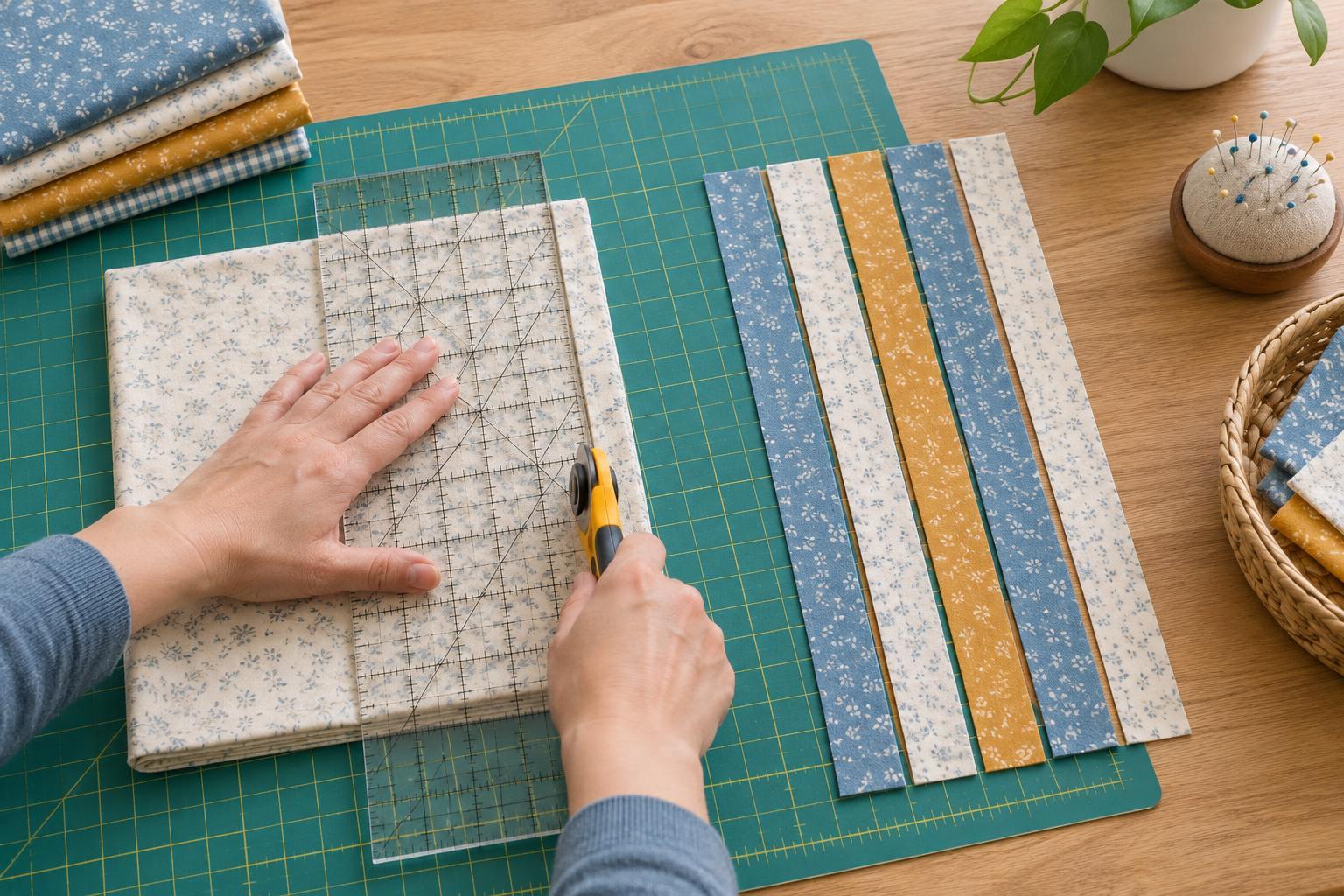
Place the fabric on the cutting mat with the long fold running horizontally. Set a quilting ruler across the fabric near one raw end. Align one of the ruler’s horizontal markings with the fold, rather than relying only on the printed lines of the mat. This makes the ruler’s cutting edge perpendicular to the fold. Trim a narrow amount from the raw end to create a clean starting edge.
Before cutting more, open the trimmed edge enough to check its shape. It should run straight across the fabric without a pronounced point at the fold. If it forms a V, stop and reset the fabric: smooth the layers, check that the fold is not angled or twisted, and make another small squaring cut. Repeating the same setup will repeat the bend.
Cut strips without shifting the layers
With the fabric still folded, measure the desired strip width from the newly squared edge. Align the appropriate ruler mark with that edge and check that a horizontal ruler marking remains parallel to the fold. Hold the ruler firmly with your hand safely away from the cutting edge. Cut along the ruler in a steady pass with a rotary cutter, following the cutter’s safety guidance.
After each cut, take a moment to see whether the fabric or ruler has moved. A ruler that pivots slightly can produce a strip that changes width from one end to the other. Reposition your hand and ruler as needed instead of reaching beyond a comfortable cutting distance. If your ruler cannot cover the full width securely, work in a manageable setup rather than trying to guide a cutter along an unstable edge.
Open the first strip before cutting the rest. Its edges should be reasonably parallel, and it should lie flat without a noticeable bend at the fold. This quick check is especially useful before cutting many strips for a quilt top.
Know when to square the fabric again
As you cut successive strips, tiny shifts can accumulate at the remaining edge. If that edge no longer looks straight, or the ruler no longer sits square to the fold, trim a small amount to square it again. This sacrifices a little fabric but can save time later when joining strips or cutting patchwork units.
If a finished strip has a slight bow, pressing may help it lie flat for a forgiving task, but pressing cannot remove a sharply angled cut. For pieces that need precise alignment, recut from a properly squared edge if you have enough fabric. A reliable routine is simple: press, fold without tension, square to the fold, cut, and inspect. Once those steps feel familiar, straight strips become much easier to repeat.