Prepare the layers before you stitch
Even hand-quilting begins with a stable quilt sandwich. Smooth the backing, batting and quilt top, then baste them securely so the layers cannot shift as you work. If you use a hoop, hold the layers comfortably flat rather than stretching them drum-tight. A taut surface can make it harder to take up fabric on the needle and may leave puckers when the quilt is released.
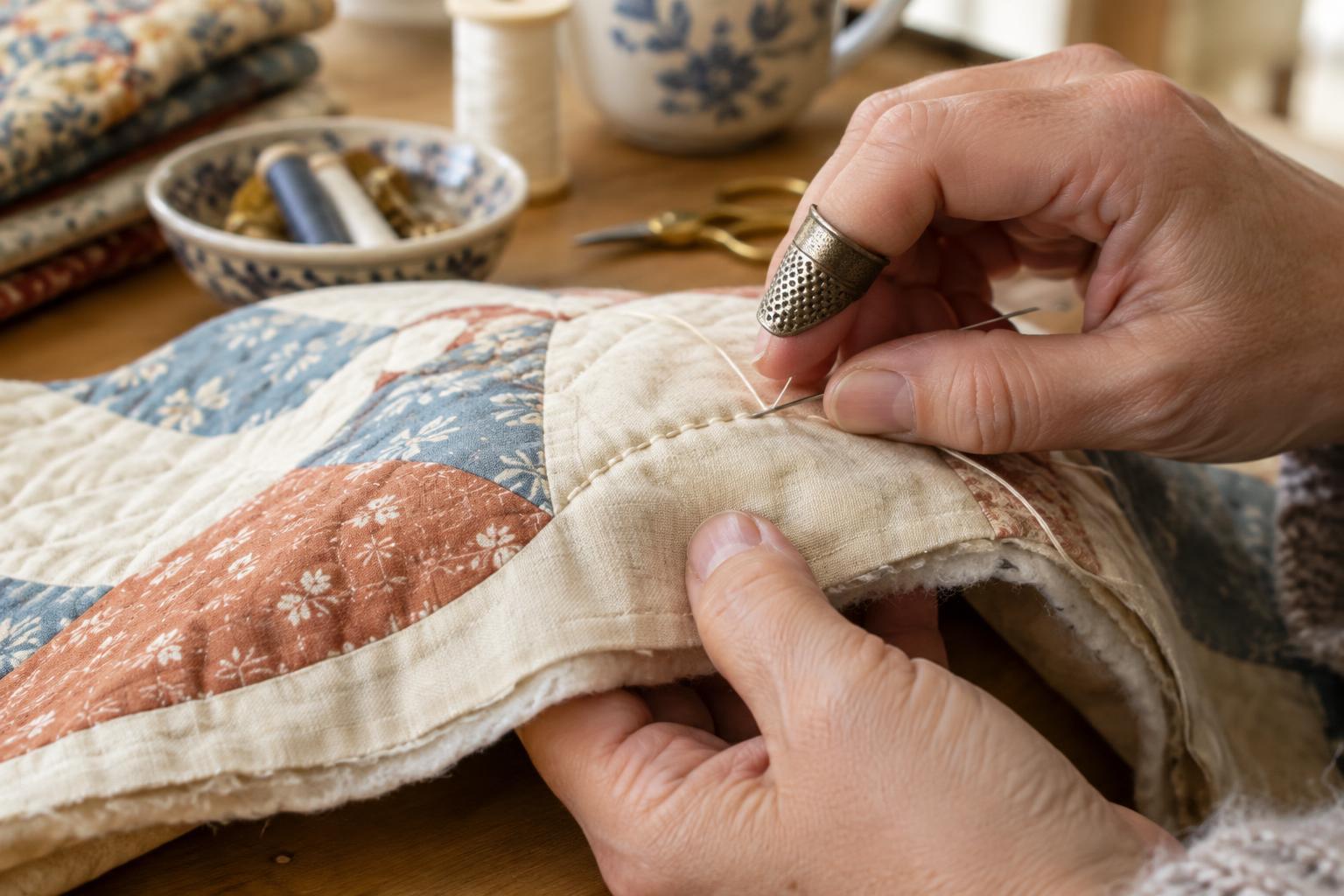
Choose a short, sharp quilting needle that you can control, along with thread suited to hand quilting. A thimble on the finger that pushes the needle protects your hand and helps you guide each movement. Cut a manageable length of thread: long thread may tangle or wear as it passes repeatedly through the fabric. Test your needle, thread and stitch on a small sandwich made from similar materials before working on the quilt.
Learn the rocking motion
The rocking stitch is a way to make several running stitches before pulling the needle through. Bring the needle up through all three layers at the start of your quilting line. Point it down a short distance ahead, then use the thimble to tip the needle back up. As the point emerges, tip it down again. This gentle back-and-forth movement gathers small folds of the quilt sandwich onto the needle.
Keep your other hand beneath the quilt to support the layers and help you sense where the needle point will emerge. Move carefully; you need only enough contact to guide the needle, not to press its point into your fingertip. Start by loading just two or three stitches before pulling the needle through. Check the back of your practice piece to confirm that each stitch catches the backing as well as the top.
Build an even rhythm
Aim for stitches that look similar along one line, rather than chasing a particular number of stitches per inch. Let the needle and thread move at a pace you can repeat. Keeping each stitch and the space after it approximately the same length will usually look more deliberate than alternating tiny stitches with long ones. Quilting through bulky seam allowances may require a slightly longer stitch or a change of direction.
Pull the thread through until it lies against the fabric without drawing the layers together. If the line puckers, ease the thread back before continuing. Every few stitches, pause to smooth the sandwich and look at both sides. Evenness comes from repeating the same hand position, needle angle and amount of pressure; speed can come later. Rotate the quilt when necessary so your hands can work in a comfortable direction.
Handle curves, corners and thread ends
For a curve, load fewer stitches onto the needle and follow the marked line in small steps. At a sharp corner, finish a stitch at the turning point, pull the thread through, rotate the quilt and begin along the new direction. Trying to load a full set of stitches across a turn often makes the line wander. Marking a guide with a method appropriate for your fabric can help, but test any marking tool first and follow its removal instructions.
To start, a small knot can be drawn into the batting layer, where it is hidden between the top and backing. Avoid pulling it all the way through the backing. When ending a thread, secure it with a small knot near the fabric, guide the needle between the layers for a short distance and trim the thread where it emerges. Practise this on your sample first so you can judge how firmly to pull.
Use a practice sandwich to troubleshoot
Quilt a few straight lines on a spare sandwich, then add a gentle curve. If stitches are long on the back, check whether the needle is passing fully through the backing before it turns upward. If stitches vary across the top, try loading fewer at a time and keeping your hands in one comfortable position. If the thread snags, check for a dull needle, a rough seam allowance or a length of thread that has begun to fray.
Your stitches do not need to be identical to make a useful, attractive quilting line. Look for steady spacing, secure stitches through all layers and a quilt that lies flat when you release it. Once those habits feel natural, you can experiment with different line shapes and stitch lengths while keeping the same controlled rocking motion.