Why pressing is different from ironing
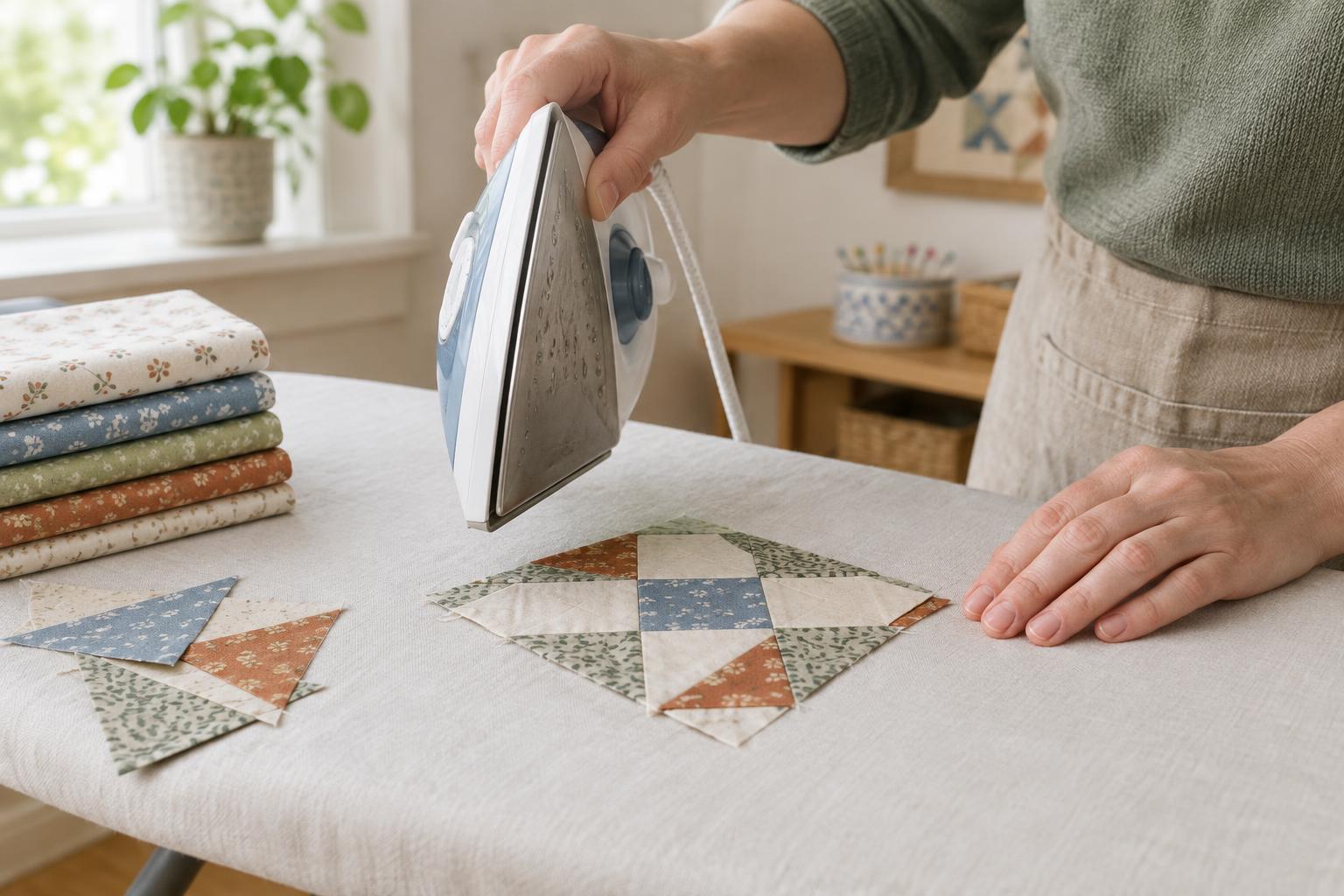
In everyday ironing, the iron often slides across the fabric to remove wrinkles. Patchwork calls for a gentler motion: place the iron on the seam, lift it, and place it again where needed. Sliding the iron, especially while pushing against a seam or an exposed edge, can shift the fabric before the block is assembled.
Stretching is most noticeable on bias edges, which run diagonally across the fabric grain. These edges can grow out of shape with surprisingly little handling. Even straight edges benefit from restraint, because an accurate seam allowance is easier to preserve when the fabric stays where it was sewn. The goal is a flat, settled seam—not a piece that has been forced into the right dimensions with heat.
Set up for a gentle press
Use a stable, heat-safe pressing surface that supports the whole piece. If a small block hangs over the edge of the board, its weight can tug at the seam while you work. Set the iron to suit the fabric and any materials used in the project. For cotton patchwork, start with a moderate setting if you are unsure, then test a scrap. Check that any pressing surface or mat is rated for the heat and steam you plan to use.
Keep your hands light, too. Smooth the patchwork into place rather than pulling opposite corners to make it look square. If a piece has a bias edge, support it as you move it from the machine to the board. You can also let a freshly pressed piece cool on the board before lifting it. This gives the seam a chance to settle without being stretched while it is warm.
A simple seam-pressing routine
After stitching, place the patchwork on the board as sewn, with the two pieces still lying together. Lower the iron briefly onto the stitched line, then lift it away. Often called setting the seam, this first step helps the stitches settle before the fabric is opened. It should take only gentle contact; there is no need to drag the iron along the line.
Next, open the pieces with your fingers and guide the seam allowance in your chosen direction. Press from the front, placing and lifting the iron along the seam. Look for a fold that sits snugly against the stitching rather than a narrow ridge of fabric tucked inside it. Turn the work over and check that the seam allowance is lying as intended. If it needs adjustment, reposition the fabric and press again instead of pulling it into place under the iron.
Choose a direction that suits the block
Pressing a seam to one side is useful when adjoining patchwork units can have their allowances pressed in opposite directions. The allowances can then meet at an intersection, making it easier to align the seams before sewing. Pressing toward a darker fabric may also help keep an allowance from showing through a lighter one, although the best choice depends on the fabric and block layout.
Pressing seams open can reduce bulk where several pieces meet, but it does not allow seam allowances to nest in the same way. Whichever approach you choose, check the instructions for a pattern if you are following one, and be consistent where units need to join. At a crowded intersection, concentrate on keeping the surrounding fabric flat rather than bearing down on the lump with the tip of the iron. A test unit can help you decide which direction gives the neatest result.
Handle steam, bias edges, and uneven blocks with care
Steam can help a stubborn seam relax, but moisture and heat also make it easier to reshape fabric unintentionally. Try pressing dry first. If you use steam, lower the iron straight down, lift it straight up, and let the piece cool before moving it. Avoid repeatedly steaming an exposed diagonal edge. If a bias edge will not be sewn into the next unit soon, handle the piece as little as possible.
When a block comes off the board wavy or larger than expected, stop before pressing it again. Check whether the seam has a tucked fold, whether an edge was pulled, or whether the stitching needs correction. Pressing can flatten a seam, but it cannot reliably fix a cutting or sewing error. For the next unit, use less pressure and fewer passes with the iron. A steady lift-and-place habit protects the fabric’s shape while still giving you crisp, workable patchwork.