Choose curves your walking foot can follow
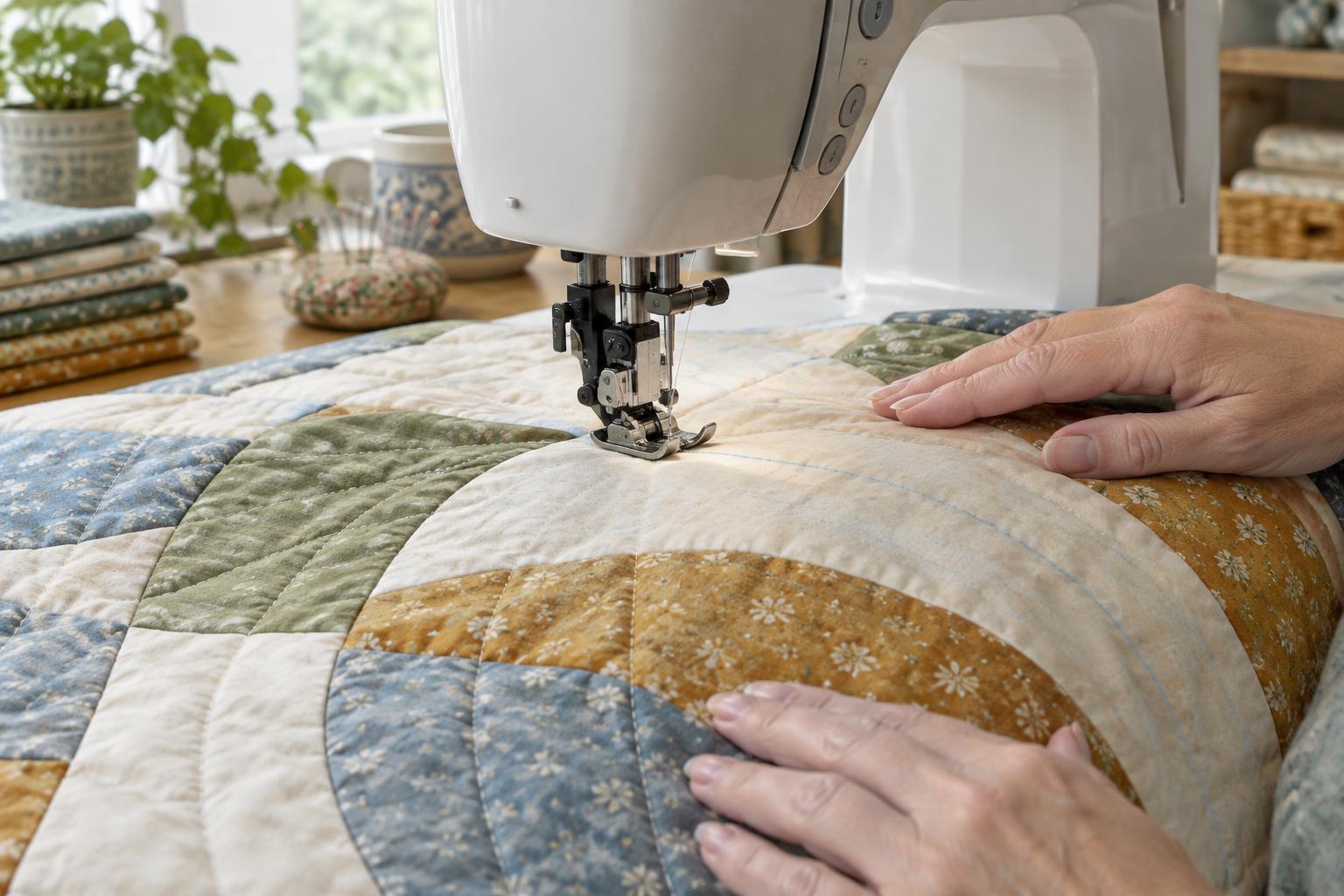
A walking foot helps move the quilt top and backing together as the feed dogs advance the layers from below. It is often used for straight-line quilting, but it can also follow a broad, gradual curve. The key is to guide the quilt gently rather than ask the foot to turn a tight corner. For small circles, sharp bends, or intricate swirls, free-motion quilting may be a better choice.
Start with a design that crosses the quilt in long, relaxed arcs. Parallel waves, shallow scallops, or a single line that wanders gently across a panel are approachable options. Leave enough room between bends for the quilt to move smoothly. Before committing to the design, trace its path with a finger: if the direction changes abruptly, soften the curve.
Prepare and mark the quilt sandwich
Careful basting matters because curves can put sideways pressure on the layers. Smooth the backing, batting, and top before securing them with your preferred basting method. Keep pins or other fasteners out of the needle’s path, and remove them as you reach them. Check the batting guidance for the maximum recommended distance between quilting lines; your design needs to hold the layers together as well as look pleasing.
For a first attempt, mark the stitching path rather than trying to steer by eye. A flexible ruler, a curved template, or a gently drawn freehand line can provide a guide. Test any marking tool on a fabric scrap and follow its removal instructions. Mark one or two lines at a time if that makes the design easier to adjust. You can also use the edge of the walking foot as a spacing guide for nearby lines, provided the curves remain broad.
Set up the machine and test your movement
Attach the walking foot according to your machine’s instructions, making sure its moving arm is correctly positioned. Fit a needle suited to your fabric and thread, then choose a stitch length that gives the layers room to advance without producing tiny, crowded stitches. There is no single setting that suits every quilt sandwich, so test your choices on a practice piece made from similar fabric, batting, and backing.
Draw a shallow wave on the practice piece and stitch along it at a comfortable, steady pace. Support the quilt on the table so its weight does not tug against the needle. Rest your hands lightly on either side of the foot, keeping them clear of the needle area. Let the machine feed the fabric; pulling or pushing it can distort the layers and affect stitch length.
Guide the curve in small, smooth changes
As you sew, look a short distance ahead of the needle and guide the marked line toward it. Turn the quilt gradually while it feeds, making small changes of direction rather than a sudden twist. Slow down as you approach a bend. If you need to reposition your hands, stop with the needle down, settle the quilt, and continue. Avoid rotating a bulky quilt sharply around a stationary needle, which can strain the fabric and disrupt the curve.
Keep the area immediately around the foot flat, but do not stretch it. On a larger quilt, pause occasionally to rearrange the bulk on the table. Stitching from a stable central area toward an edge can help you manage the layers; for long rows, check after each pass that the backing remains smooth. If a line strays slightly, a gentle curve often makes the variation less noticeable than a forced correction would.
Finish the lines and assess the texture
At the end of a line, secure the threads in a way that suits the project. You might take a few small securing stitches where they will be inconspicuous, or leave tails long enough to bury between the quilt layers. Trim loose threads after checking both sides of the quilt for loops or puckers.
Step back and look at the overall texture before adding more lines. Curves do not need to be identical to feel cohesive, but their spacing should look intentional and meet the batting’s quilting requirements. If one area looks sparse, add another broad line rather than squeezing in a tight turn. With a little practice, gentle curves can give a quilt a soft sense of movement using the same walking foot you rely on for straight lines.