Choose a finish before you begin
Every quilting line needs a way to keep its first and last stitches from loosening. Two useful options are to secure the thread with several very short stitches or to knot and bury the thread tails. Some quilters use both: a few small stitches for security, followed by buried tails for a clean surface. The best choice depends on the visibility of the quilting, the thread, and how easily your machine makes short stitches.
Before working on the quilt, test your chosen method on a small layered sample made with similar fabric, batting, and thread. Check both sides. A finish that disappears on a busy print may stand out on a plain backing, and repeated stitches can make a noticeable lump.
Bring the bobbin thread to the top
When starting a new line of machine quilting, bring the bobbin thread up before stitching so it cannot be caught in a tangle underneath. Hold the top thread tail, lower the needle into the quilt at your starting point, and raise it again. Gently pull the top thread until a loop of bobbin thread appears. Lift that loop with a pin or your fingers, then move both tails out of the stitching path.
Leave several inches of each tail if you plan to bury them. Short tails are difficult to thread through a hand needle later. If your design begins at the quilt edge, you may instead be able to secure the line within an area that the binding will cover. Take care not to rely on the binding to hold stitches that fall outside its seam.
Secure the beginning and end of a quilting line
To secure a line with stitches, make several very short stitches at the start before moving to your normal stitch length. At the end, shorten the stitches again for a few stitches, then stop with the needle raised. The stitches should be close enough to resist coming undone without building up a hard spot. If your machine has a tie-off function, test its appearance on a sample; it may stitch repeatedly in one place, which can be visible.
If you prefer to bury tails without a stitched tie-off, leave both tails long at the start and end. Avoid tugging on an unsecured line while you reposition the quilt. At the end of a line, cut the threads with enough length to handle rather than trimming them close to the fabric. Turning the quilt over will show where the bobbin tail needs to be buried, even if the top tail is easier to see from the front.
Bury thread tails inside the quilt
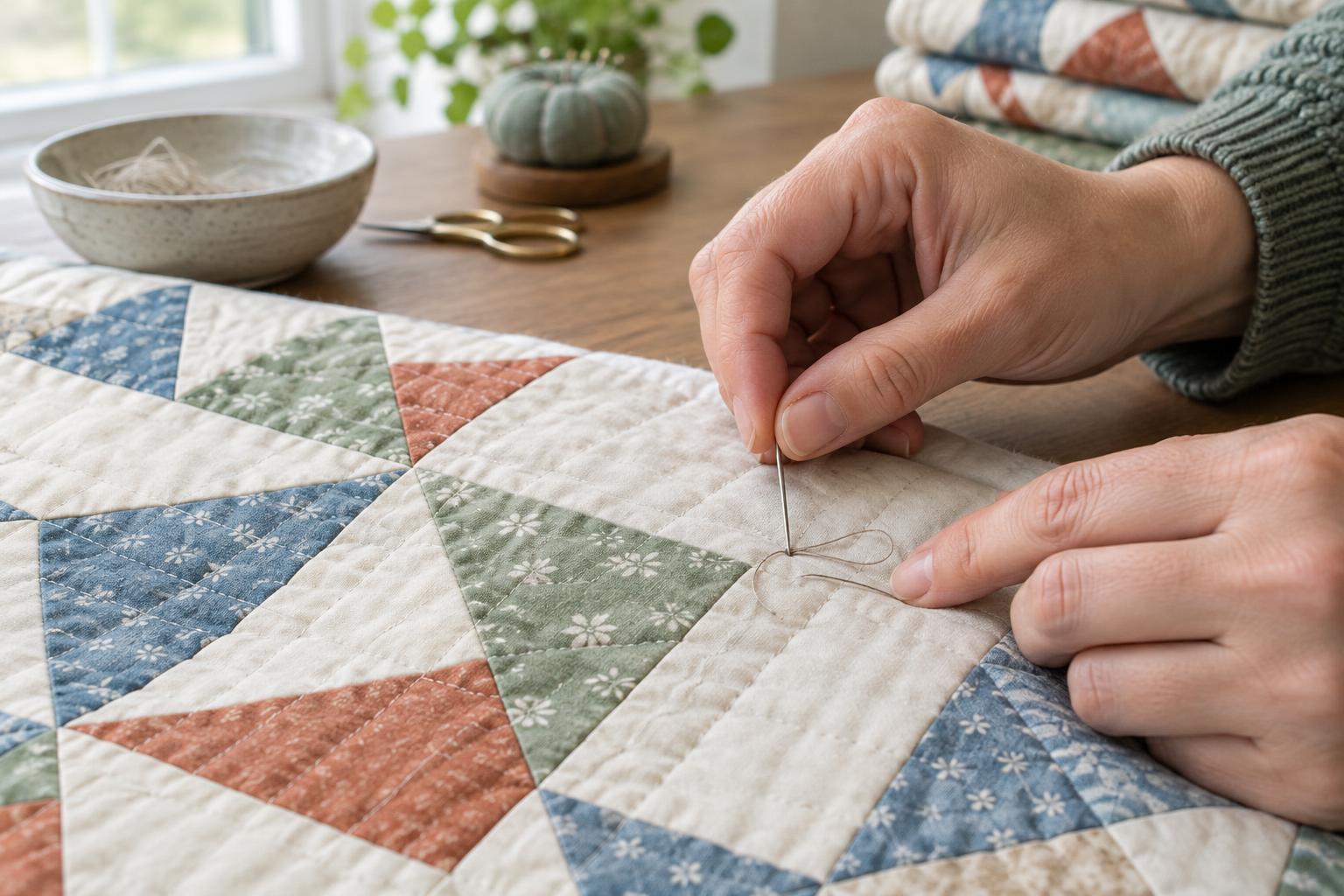
Thread a tail through a hand-sewing needle, using a needle with an eye large enough for the thread but a point fine enough to enter the quilt without leaving an obvious hole. If the tail is too short to pass through the eye, place the needle through the quilt first, thread its eye while it is partly exposed, and then pull it through.
For a tidy finish, tie the top and bobbin tails together with a small knot close to the quilt surface if both are accessible on the same side. Insert the needle near the last stitch, pass it between the quilt top and backing through the batting for an inch or two, and bring it out away from the quilting line. Gently draw the knot into the quilt layers, then snip the tail close to the fabric while holding it slightly taut. Let the fabric relax so the cut end slips inside. If the tails are on opposite sides, bury each from its own side rather than pulling a thread visibly through the quilt.
Keep the needle within the layers instead of piercing through to the other side. Do not pull so hard that the fabric puckers or the knot pops through. A knot that will not slip neatly inside can be left out if the stitches are already secured; burying the remaining tail still removes the loose end.
Check the finish from both sides
After burying a few tails, turn the quilt over and look for stray loops, visible knots, or thread that has crossed the backing. Run a fingertip lightly over each finished end to check for a lump. If a tail reappears, use a needle to guide it farther into the batting rather than cutting it shorter at the surface.
Finishing as you go can keep a large quilt from becoming a collection of easily missed tails. Whether you bury them after each line or at the end of a quilting session, keep the quilt well lit and check both sides before adding the binding.