Why test before you cut?
A quilt often places dark and light fabrics side by side. If dye moves from one fabric to another during washing, pale patches may pick up unwanted colour. Testing a small piece before cutting is easier than trying to deal with transferred dye after the quilt is assembled.
Colourfastness is not an all-or-nothing quality. A fabric might release colour into water, leave colour on another fabric when rubbed, or behave differently after repeated washes. Dark, saturated prints are worth checking, but colour alone cannot tell you whether a fabric will bleed. When in doubt, test any fabric that will sit next to a much lighter one.
Set up a small water test
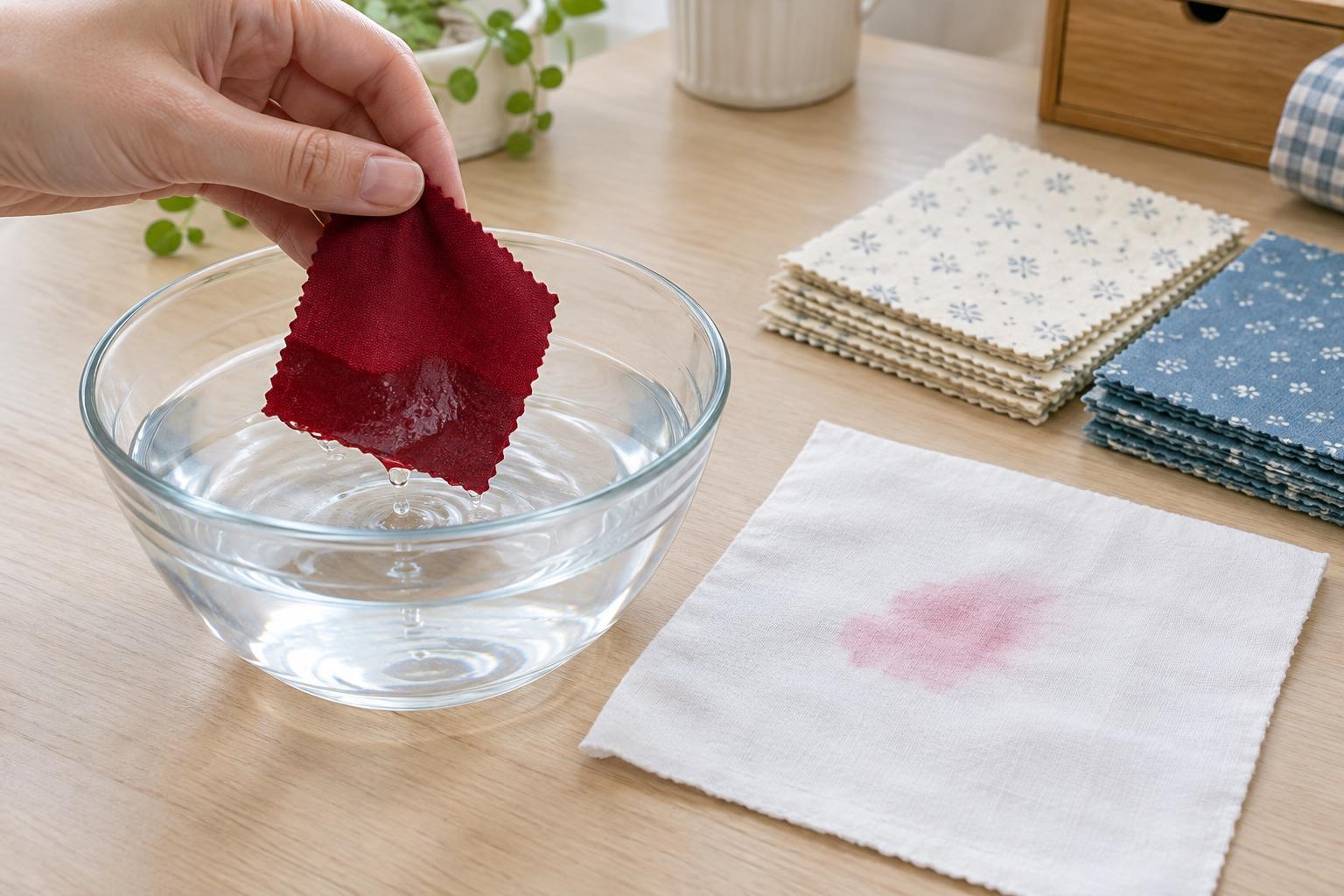
Cut a small swatch from the fabric or use a piece from the edge that will not be needed for the quilt. Keep enough of it to identify the fabric later. Gather a clear bowl, clean water, a scrap of plain white cotton and a white towel or paper towel. Test one coloured fabric at a time so you can tell which swatch caused any change.
Use water at a temperature close to the one you expect to use when washing the finished quilt. If you intend to wash the quilt with a mild detergent, you can also run a second test with a little of that detergent. Soak the swatch for about 20 minutes, then gently move it through the water. Coloured water is a warning sign, though a slight tint does not always mean the dye will mark another fabric. The white cotton in the next step gives you a more useful check.
Check for transfer, not just tinted water
While the swatch is wet, place it against the white cotton and press them together with your hands. Leave them in contact for a few minutes, then separate them and look for staining. Next, lay the swatch between parts of the white towel and press out some moisture. Check both white surfaces for colour. Let the cotton dry before making a final judgement; faint transfer can be easier to see once the fabric is dry.
You can also check for rubbing transfer, sometimes called crocking. Rub a dry white cotton scrap across the coloured fabric several times, then repeat with a slightly damp white scrap. If either picks up colour, consider how that fabric will be handled and washed in a quilt. A wet test and a rubbing test look for different kinds of transfer, so passing one does not make the other unnecessary.
What to do if the fabric releases dye
If the white cotton stains, the simplest choice is to leave that fabric out of a quilt with pale neighbours. You could use it in a separate project where staining is less visible, but test it against any fabric it will touch. For a fabric you particularly want to use, try washing it separately according to its care instructions, then test a fresh swatch again. Repeat washing may reduce loose dye, but it may not solve the problem.
A colour-catching sheet can be an extra precaution during washing, not a substitute for testing or a guarantee against transfer. Likewise, vinegar or salt should not be relied on to make an uncertain fabric colourfast. If the fabric continues to stain white cotton, plan as though it may stain quilt blocks too.
Apply the result to your quilt plan
Keep tested swatches with a note of the test conditions and results. That record is useful if you pause the project or buy more fabric later. If you plan to prewash, decide whether to prewash all the fabrics in the quilt so that differences in shrinkage and texture are less surprising. Follow any care instructions supplied with the fabric, especially for materials that should not be soaked or washed like ordinary quilting cotton.
Even a fabric that passes a small test may behave differently in a finished quilt, particularly after longer soaking or a change in washing conditions. For the first wash, use a gentle cycle suited to the quilt’s materials, avoid leaving it wet in a heap and check it promptly for transfer. Testing cannot remove every risk, but it helps you make a considered fabric choice before the pieces are sewn together.