What the hoop is meant to do
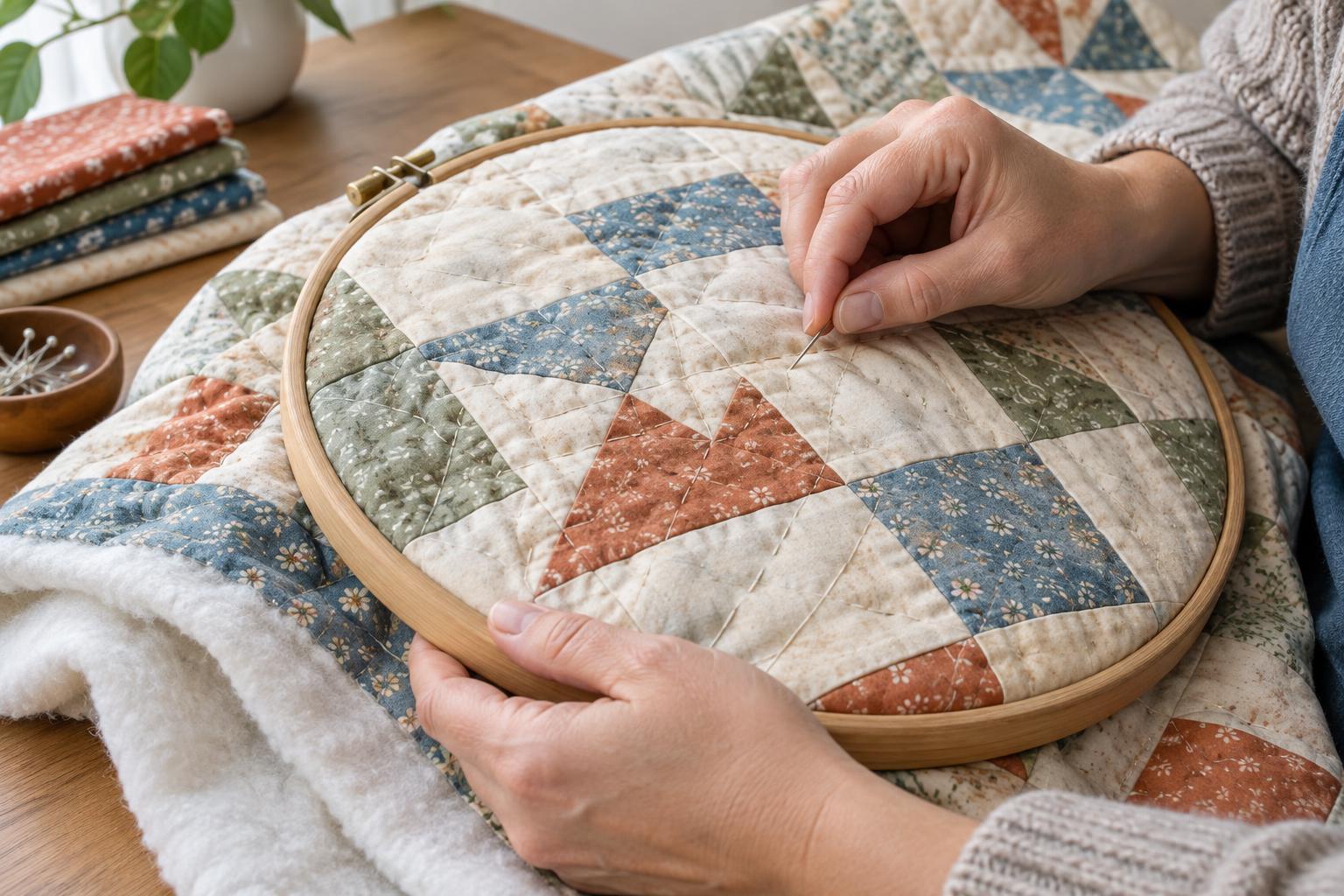
A hoop gives you a manageable area to hold while you hand quilt. It keeps the top, batting and backing supported, but it does not need to make them perfectly flat and rigid. Hand quilting is easier when the sandwich has a little give: the needle can travel through the layers, and you can guide it back up to make the next stitch.
If the quilt feels as tight as a drum, try loosening the hoop. Excess tension can make the needle harder to move and may leave the fabric looking puckered when you release it. Aim instead for a surface that stays in place while you work but yields slightly when you press it with a finger. The exact feel will vary with the fabric, batting and thickness of the quilt.
Prepare the quilt sandwich first
A hoop cannot take the place of basting. Before quilting, smooth the backing, batting and top together and secure them with your preferred basting method. Work from the centre outward as you baste so loose fabric is less likely to collect in one area. Check that the backing lies smoothly; a fold hidden underneath can be difficult to correct after you have stitched across it.
Choose a hoop that holds a useful working area without forcing you to reach awkwardly into its centre. A hoop made for quilting often has deeper sides than an embroidery hoop, which can help it grip a thicker sandwich. Whatever hoop you use, check that its edges are smooth and its fastener is easy to adjust. If you are new to the feel of hoop tension, practise on a small basted sample made with similar materials.
Set the hoop with gentle tension
Separate the rings and place the inner ring beneath the area you want to quilt. Lay the quilt sandwich over it without tugging at the corners or edges. Fit the outer ring over the top and press it down gently and evenly. Tighten the fastener only enough to keep the rings from slipping during normal stitching. If the quilt has deep seams or bulky joins, shift the hoop slightly if you can, rather than forcing it over a lump.
Run a hand across the working area and look at both sides. The top should not have obvious folds, but it need not be stretched smooth under force. Press lightly near the centre: you should feel some movement. If the fabric looks strained along a seam or the backing has been pulled in a different direction from the top, release the hoop and set it again. Loosening and resetting is usually more helpful than trying to fix the tension by pulling on the quilt while it is clamped.
Stitch within the supported area
Begin with a quilting line you can reach comfortably without twisting the hoop. Use your free hand beneath the quilt to feel where the needle comes through the backing. A thimble on the pushing finger can make the repeated movement more comfortable. Many hand quilters use a gentle rocking motion, taking one or a few stitches at a time; there is no need to force the needle through a large stack of stitches.
Check the back periodically, especially when you first begin. You want the quilting thread to pass through all the layers, without catching a fold of backing. If your stitches become difficult to form, your hand feels cramped, or the layers seem to shift against one another, pause and reassess the hoop. Stitch size may change as you cross seams or thicker patches; steady, comfortable movement matters more than forcing every stitch to look identical.
Move the hoop and release it when you stop
When you have quilted the area you can reach easily, loosen the outer ring before moving the hoop. Lift it away rather than dragging it across the surface. Smooth the next area with your hands, check the backing, and reset the rings with the same gentle tension. Avoid clamping directly over a raised join or a dense patch of finished quilting when another position will give you a flatter grip.
Take the quilt out of the hoop at the end of a session, particularly if it may sit for a while. This helps avoid a persistent ring crease and gives you a chance to inspect both sides. If you notice a small pucker, check whether it disappears when the hoop is removed before changing your stitching. A hoop is a support you can keep adjusting, not a test of how tightly you can stretch the quilt.