What basting needs to do
A quilt sandwich has three layers: the quilt top, batting and backing. Basting holds them in place until quilting stitches take over. If the layers shift, the top may develop tucks or the backing may fold under itself. Good basting does not have to make the layers rigid; it needs to keep them aligned while you handle and quilt the project.
Before choosing a method, consider the size of the quilt, how you plan to quilt it and where you can spread it out. A small project may be easy to manage on a table, while a bed-sized quilt needs more room and patience. Hand quilting and machine quilting can also place different demands on the basting: pins may interrupt a hand-quilting path, while loose basting threads may need attention near a machine needle.
Prepare a smooth quilt sandwich
Press the quilt top and backing, and remove loose threads that could show through a light fabric. Cut the batting and backing larger than the top so their edges remain beyond it as the layers settle. Lay the backing right side down on a clean, flat surface, smooth the batting over it, then place the top right side up. Align the layers without pulling any one of them tight.
Work from the centre towards the edges, smoothing wrinkles as you go. If you use tape or clamps to hold the backing on a table, keep it flat rather than stretched. Check the underside before and during basting; a backing crease can be hard to spot from above. The same preparation helps whichever basting method you choose.
Pin basting: adjustable and reusable
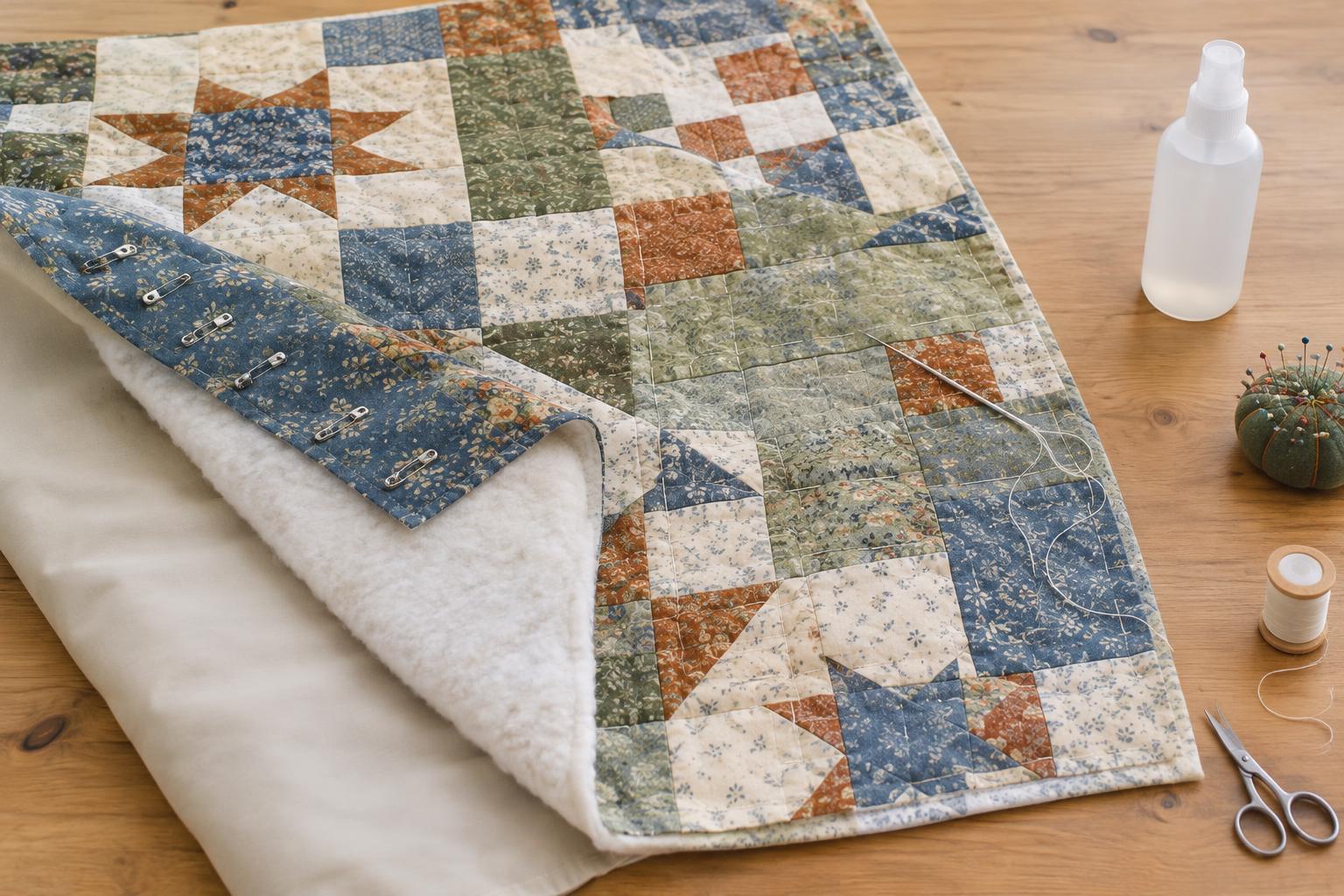
Curved safety pins are a practical choice when you want a method that uses no adhesive and can be adjusted easily. Starting near the centre, place pins across the quilt in a loose grid, working outward. Put them close enough that the layers do not shift between pins; a project with small pieces or slippery fabric may need more pins than a stable, closely quilted one. Close each pin as you go and check that it catches all three layers.
Pins are reusable, and you can move one if you find a wrinkle. Their drawbacks are the time spent opening and closing them and the need to remove them as you quilt. Keep pins out of the immediate path of a machine needle, and never sew over one. If you plan to hand quilt, consider whether stopping frequently to move pins will disrupt your stitching rhythm.
Spray basting: fewer interruptions while quilting
Temporary basting spray can hold the layers together without pins in your stitching path. It is useful when you want to move smoothly across the surface during machine quilting, particularly on a project you can lay out and handle comfortably. Apply it lightly, one section at a time, following the product’s directions for which surfaces to spray. Smooth each layer into place without stretching it, and lift and reposition a section if it develops a wrinkle.
Spray requires a suitable workspace. Follow the label’s ventilation and surface-protection instructions, and keep overspray away from surrounding furniture and tools. Check that the product is appropriate for your fabrics and batting, especially if the quilt has delicate materials or will not be washed. More adhesive is not necessarily better: a heavy application may make the quilt unpleasant to handle or quilt.
Thread basting: a simple choice for handwork
Thread basting uses long, temporary stitches to hold the sandwich together. With a needle and a contrasting thread, stitch from the centre outward in rows or a broad grid, making sure each stitch passes through all three layers. Keep the stitches long enough to remove easily but secure enough to prevent shifting. Avoid pulling the thread tight, which can gather the fabric.
This method uses no pins or adhesive and can be comfortable for hand quilting because the temporary stitches lie relatively flat. It takes time to put in and remove, however. If you machine quilt, watch that loose thread ends do not catch as you guide the quilt. Remove basting stitches as your permanent quilting secures each area, taking care not to cut the quilting thread.
There is no single best method for every quilt. Choose pins if you value adjustability and reuse, spray if you want an unobstructed stitching surface and have an appropriate workspace, or thread if you prefer a quiet, low-equipment approach. You can also combine methods—for example, using a few pins to steady an area while you thread baste it. Whatever you choose, pause early in the quilting to check both sides for shifting; correcting a small problem then is easier than fixing a finished tuck.