Why the edge matters on a wall quilt
A wall quilt is often viewed from several steps away, so its outer edge becomes part of the composition. A narrow line of fabric can contain a busy design, repeat a colour from the centre or give a small quilt a stronger outline. An edge with no visible frame can have the opposite effect: shapes and quilting appear to run right up to the boundary.
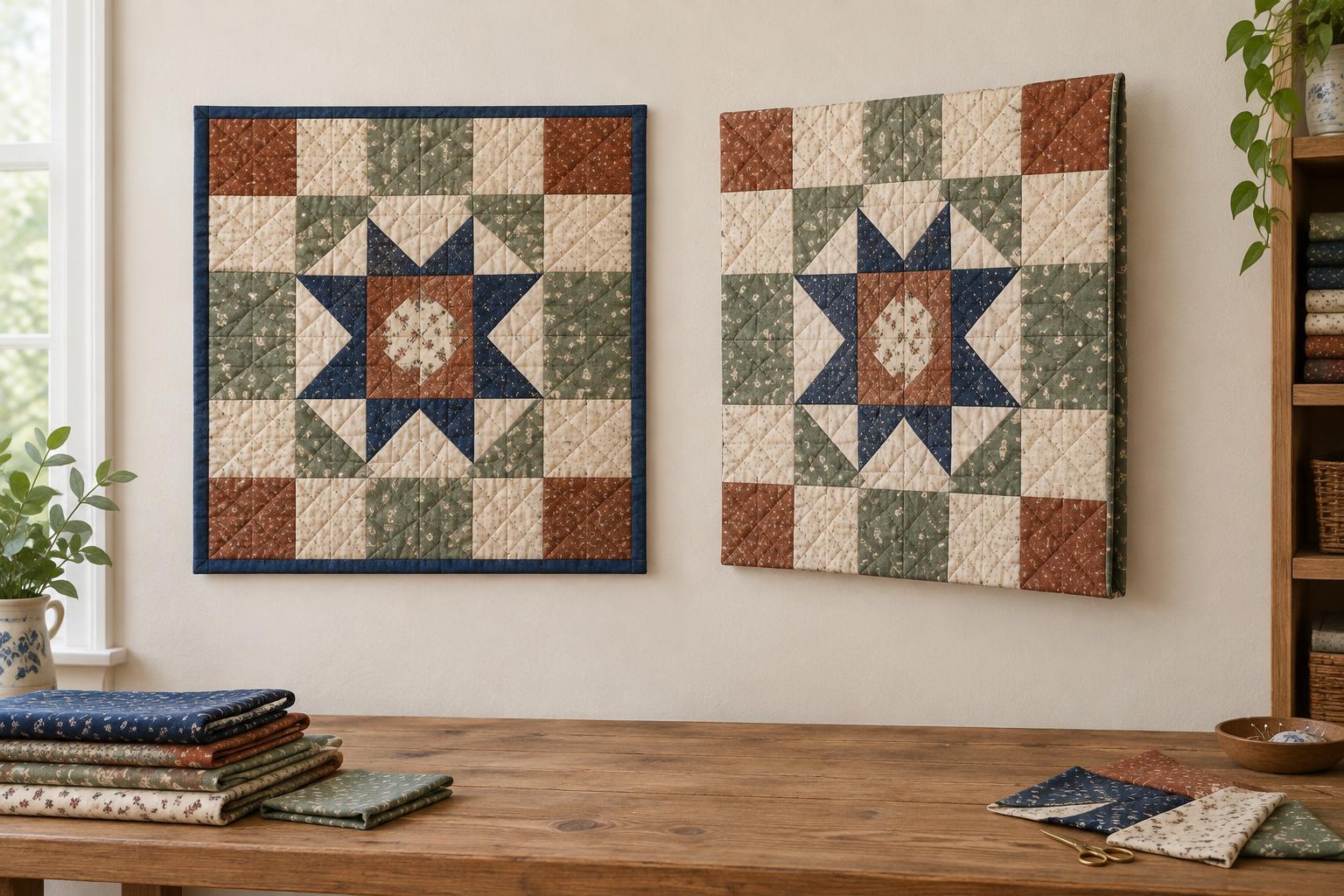
Binding and facing can both cover the raw edges of a quilt sandwich. The main difference is where the finishing fabric sits. Binding wraps around the edge and remains visible from the front. Facing is sewn to the front, turned completely to the back and secured there. Neither is automatically neater or more durable; good results depend on accurate preparation and stitching.
Choose binding when the edge should be seen
Binding works well when a quilt needs a visual frame. A fabric that echoes one of the quilt’s colours can make scattered patches feel connected. A contrasting binding can sharpen the outline, especially when the quilt hangs against a wall of a similar colour. Before cutting strips, lay candidate fabrics beside the quilt and step back. A binding that looks subtle up close may read as a strong border from across the room.
To make binding, join fabric strips, fold the long strip lengthwise and stitch it to one side of the quilt. Fold it over the raw edge and secure it on the other side. The strip width and seam allowance determine how much fabric shows on the front, so make a small sample if a precise visual width matters. Take particular care at the corners: consistent folds and even stitching help the frame look deliberate rather than uneven. A narrow binding can be effective, but it must still cover the seam securely.
Choose facing for an uninterrupted front
Facing suits a wall quilt whose design benefits from reaching the edge. It can be useful for an abstract layout, an irregular arrangement of colour or a quilt where an added outline would compete with the piecing. Because the facing sits on the back, the front shows the quilt top and quilting without a visible band of finishing fabric.
A facing can be made from strips sewn around the perimeter or from a shaped piece that follows the quilt’s outline. After stitching it to the front, trim excess bulk where appropriate, turn the facing to the back and press carefully. Then secure its inner edge by hand or with stitching suited to the design. Keep the facing from rolling onto the front; gentle pressing and attention to the corners help. If the quilt has sharp corners, test the method on a scrap quilt sandwich before finishing the full piece.
Make the decision before trimming
The finish affects how you plan the perimeter. Check that the quilt lies flat, its edges are where you want them and important piecing or quilting will not be caught in the finishing seam. Square a rectangular quilt only as much as needed; aggressive trimming can change its proportions or remove design details. If the quilt has intentionally shaped edges, choose a finish that follows them without pulling or bunching.
Consider what will happen at the back, too. A hanging sleeve needs enough room to hold a rod without pushing against the top edge. Plan its position alongside the binding or facing so attachment stitches do not show unexpectedly on the front. A small label can be added to the back without crowding the sleeve. For either finish, check that the batting is enclosed, the corners are secure and the quilt hangs without the edge curling forward.
A simple way to compare both finishes
If you are undecided, photograph or view the unfinished quilt against its intended wall. Place a narrow strip of possible binding fabric along one edge, then remove it and compare the two views from the same distance. Ask whether the outline clarifies the design or distracts from it. For a quilt with a busy perimeter, binding may provide a useful stopping point. For a design that feels complete without a border, facing may preserve that effect.
Whichever finish you choose, handle the finished quilt by its body rather than tugging on an edge when moving or hanging it. Keep it out of prolonged direct sunlight where possible, and check the sleeve and perimeter stitches occasionally. A successful wall-quilt finish should support the design while remaining secure through ordinary handling.