What the grain changes
Binding is the fabric strip that wraps around a quilt’s raw edges. Where you cut that strip affects how readily it bends. Straight-grain binding runs parallel to either the lengthwise or crosswise threads of the fabric. Lengthwise grain is usually the most stable; crosswise grain generally has a little more give. Both are far less flexible than binding cut on the bias.
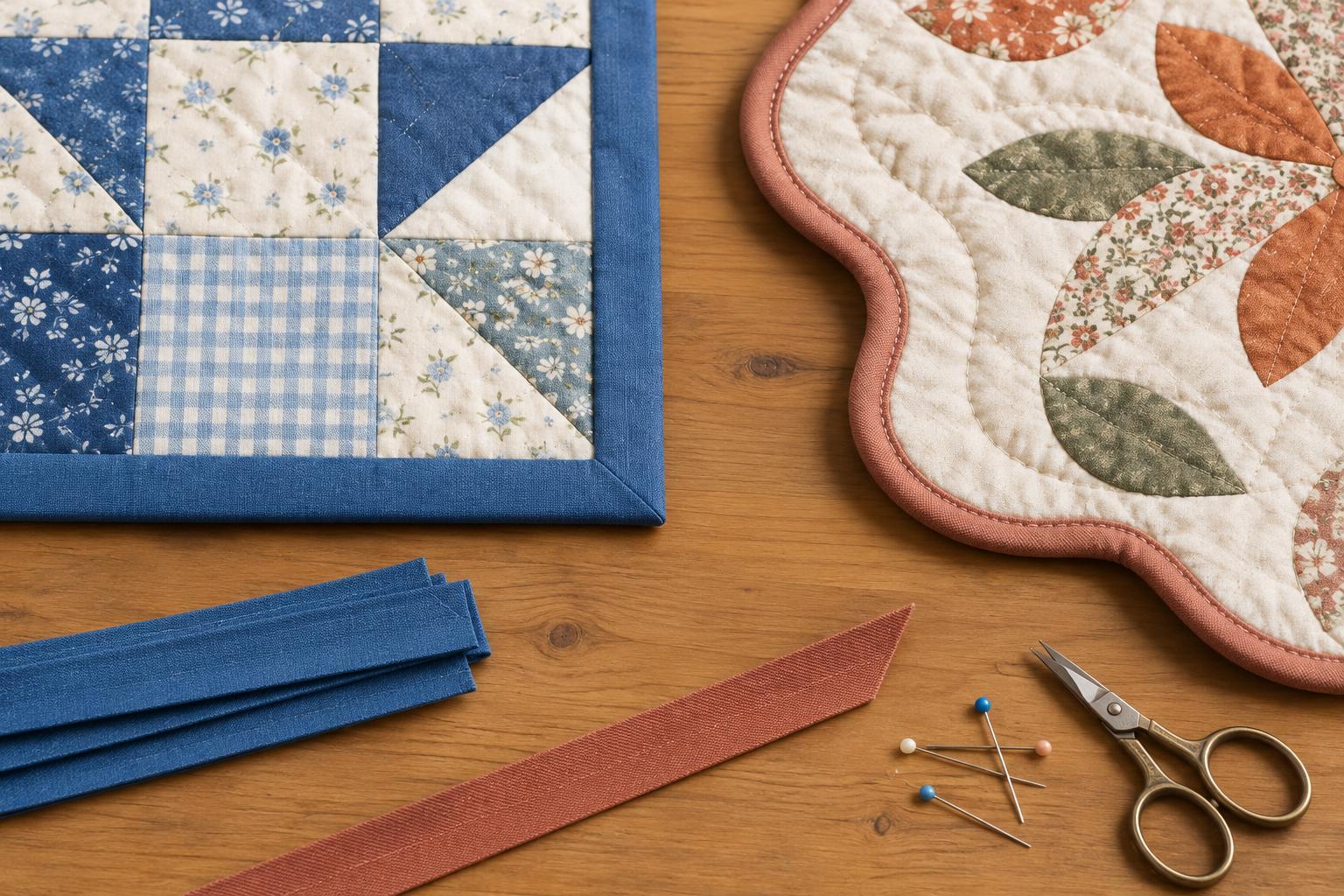
Bias binding is cut diagonally across the fabric, typically at about 45 degrees to the selvage. It stretches and curves more easily because the woven threads can shift in relation to one another. That flexibility is useful around a shaped edge, but it also means the strip needs gentle handling. If you pull it as you sew, it can lengthen unevenly and leave the quilt edge wavy.
Choose straight grain for square or rectangular quilts
If your quilt has straight sides and conventional square corners, straight-grain binding is usually the simplest choice. It is easy to cut into strips, join, press and guide along the edge without accidentally stretching it. Crosswise strips cut from fabric width are common for this job. Lengthwise strips can be useful when you want a particularly stable edge or a print that looks better running in that direction.
Straight-grain strips can turn a square corner neatly: sew toward the corner, fold the strip to form a miter, then continue along the next side. The exact stopping point depends on your seam allowance and binding width, so check that the folded binding will cover the stitching on the reverse. A crisp miter comes more from accurate folding than from using bias fabric.
Choose bias for curves and scallops
A rounded, scalloped or otherwise curved perimeter asks the binding to follow a longer path on one edge of the strip than on the other. Bias binding can accommodate that difference. On an outward curve it spreads gently; on an inward curve it can ease into the shape. Straight-grain binding is more likely to resist the turn, creating puckers or a ridge that will not lie flat.
Bias is also helpful when a quilt has several angled changes of direction rather than ordinary square corners. It is not automatically necessary for every unusual shape: a quilt made mostly of straight segments may still take straight-grain binding well. Consider the tightest curve on the perimeter. A broad, shallow curve may be manageable with a slightly forgiving crosswise strip, while a small scallop is a stronger reason to cut on the bias.
Plan the strips before you sew
For either method, measure the perimeter and allow extra length for joining the strips and finishing the two ends. Choose a strip width that suits your seam allowance and the amount of binding you want visible on each side. Many quilters fold a strip lengthwise to make double-fold binding, which gives the edge two layers of fabric. Make a short test piece with your quilt’s batting and backing if you are unsure whether your chosen width will wrap comfortably.
Join strips with diagonal seams to spread the seam allowances across the binding rather than stacking them in one bulky line. For bias binding, keep the strips supported while cutting and sewing; letting a long length hang from the table can stretch it. Press without dragging the iron along the fabric. Marking a gentle curve or clipping the binding in place before stitching can help you distribute it evenly without pulling.
Fit and finish matter more than a fixed rule
Whichever grain you choose, check the edge as you sew. The binding should sit smoothly against the quilt, without gathering the quilt top or being stretched tight around it. At curves, work in short sections and adjust the strip so its raw edges stay aligned with the quilt’s raw edge. At corners, pause to arrange the fold rather than forcing extra fabric under the presser foot.
After attaching the first side, fold the binding over and confirm that it covers the stitching line on the other side. Secure it by hand or machine, then look for gaps, twisted sections and areas that feel too tight. The practical rule is straightforward: use the stability of straight grain where the edge is straight, and the flexibility of bias where the edge needs to bend.