See the cube in three diamonds
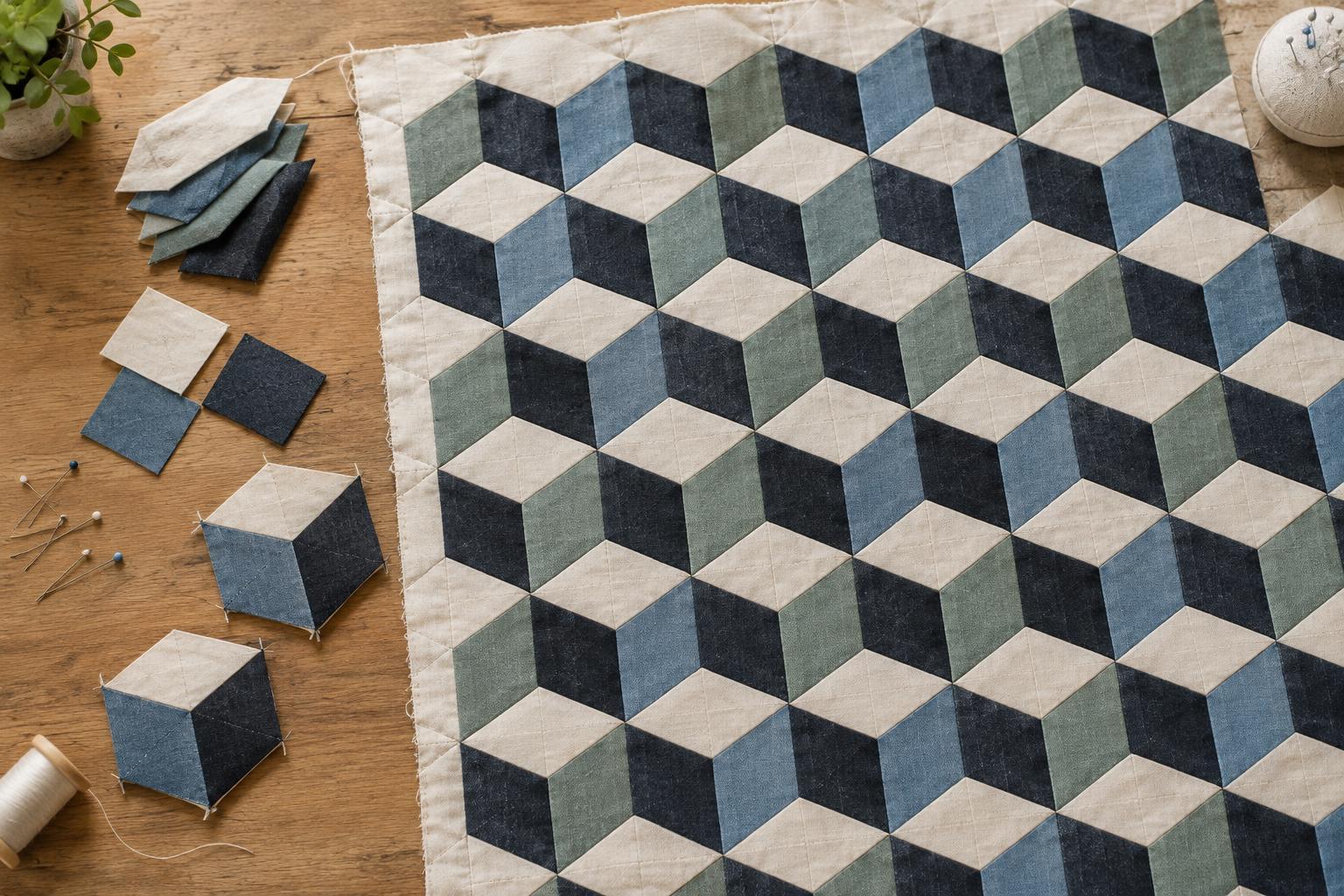
Tumbling Blocks is a patchwork pattern built from diamonds. Three equal diamonds meet at one point to form a hexagon that can look like the top and two sides of a cube. The effect comes from value—the relative lightness or darkness of a fabric—rather than from a complicated print. Once you recognise those three faces, you can repeat the unit across a larger quilt or make a small piece to practise the arrangement.
Use a 60-degree diamond template: its corners alternate between 60 and 120 degrees. At the centre of each apparent cube, three 120-degree corners meet. Before cutting fabric, draw or arrange three paper diamonds to check the shape. Rotate them until their wide corners touch and the outside edge forms a hexagon. This quick rehearsal also makes the piecing sequence easier to understand.
Choose fabrics that make the shape readable
For a clear first attempt, select one light, one medium and one dark fabric. Place the light diamond in the same position in every cube, such as the upper face, and keep the medium and dark diamonds on their chosen sides. Repeating that arrangement suggests a consistent direction of light. If the values change position from block to block, the design may still be lively, but individual cubes can become harder to pick out.
You do not need three shades of one colour. A pale blue, a mid-value green and a deep navy can work together if their values remain distinct. To assess a combination, place small fabric pieces side by side and squint at them, or view a photograph in grayscale. Prints can add interest, but a busy print may blur a diamond’s edge. If you want to use several prints, test three cut diamonds together before preparing a whole quilt’s worth.
Plan the layout before you sew
Cut a few sets of paper diamonds and arrange them on a table or design surface. Make one complete cube, then repeat it with the light, medium and dark faces in the same positions. Photograph the layout so you can restore it if the pieces are disturbed. Labeling the three fabric groups can also help when you are cutting and sorting many identical shapes.
Decide whether you want cubes packed edge to edge or separated by background space. A continuous field makes the optical pattern the focus; space around individual cubes gives the eye a place to rest. For a manageable first project, try a cushion front or a small wall hanging rather than committing to a bed-size layout. Make a sample unit and measure its finished size before calculating how many you need.
Whatever the project, cut accurately using a template that includes your chosen seam allowance, or add that allowance consistently when cutting. Take care with the diamond’s angled edges, which can stretch if handled roughly. Keeping the pieces flat as you cut and sew will make the meeting points easier to align.
Piece the diamonds in a way that suits you
Machine piecing a three-diamond unit involves an inset, or Y-shaped, seam. Sew the first two diamonds together along one edge, stopping at the seam intersection rather than stitching into the seam allowances. Add the third diamond along one open edge, then pivot the work to join its remaining edge. Marking the seam intersections on a sample set helps you see exactly where each line of stitching should stop. Press gently after the unit is complete.
English paper piecing offers a slower, portable alternative. Baste each fabric diamond around a matching paper shape, then join adjacent edges by hand with small stitches. The papers help maintain the angles while you work. Remove them only when the surrounding seams support the fabric and you no longer need the paper to hold its shape. Either method benefits from a practice cube: it lets you check your fabric placement and seams before repeating the unit.
Keep the illusion clear as the project grows
As you join more units, pause to look at the work from a distance. Check that each apparent cube has the intended light, medium and dark faces, and compare it with your layout photograph. An accidentally rotated set can interrupt the illusion, but spotting it early is much easier than finding it after several rows are joined.
Let the patchwork guide your quilting choices. Stitching that follows the diamond seams can emphasise the geometry; a simple, even quilting texture can leave the colour arrangement in charge. There is no need to outline every cube. The most useful finishing choice is one that holds the layers securely without making the points and value changes difficult to see.